A working-through of hybrid geometry charts, what separates one price tier of components from the next, and the running costs that turn up long after the purchase.
Three times the price does not buy three times the bike, and the gap between the two ends of that range is unevenly distributed across the parts. Some of the money lands on things you feel within the first mile, some lands on things you feel after a year of weather, and a surprising share lands on the frame material and the paint, which change the number on the scale and very little else on a flat bike path. A careful reader can tell them apart from the spec sheet, if the spec sheet is honest enough to name model numbers rather than adjectives.
Brakes, and the moment hydraulic stops being a luxury
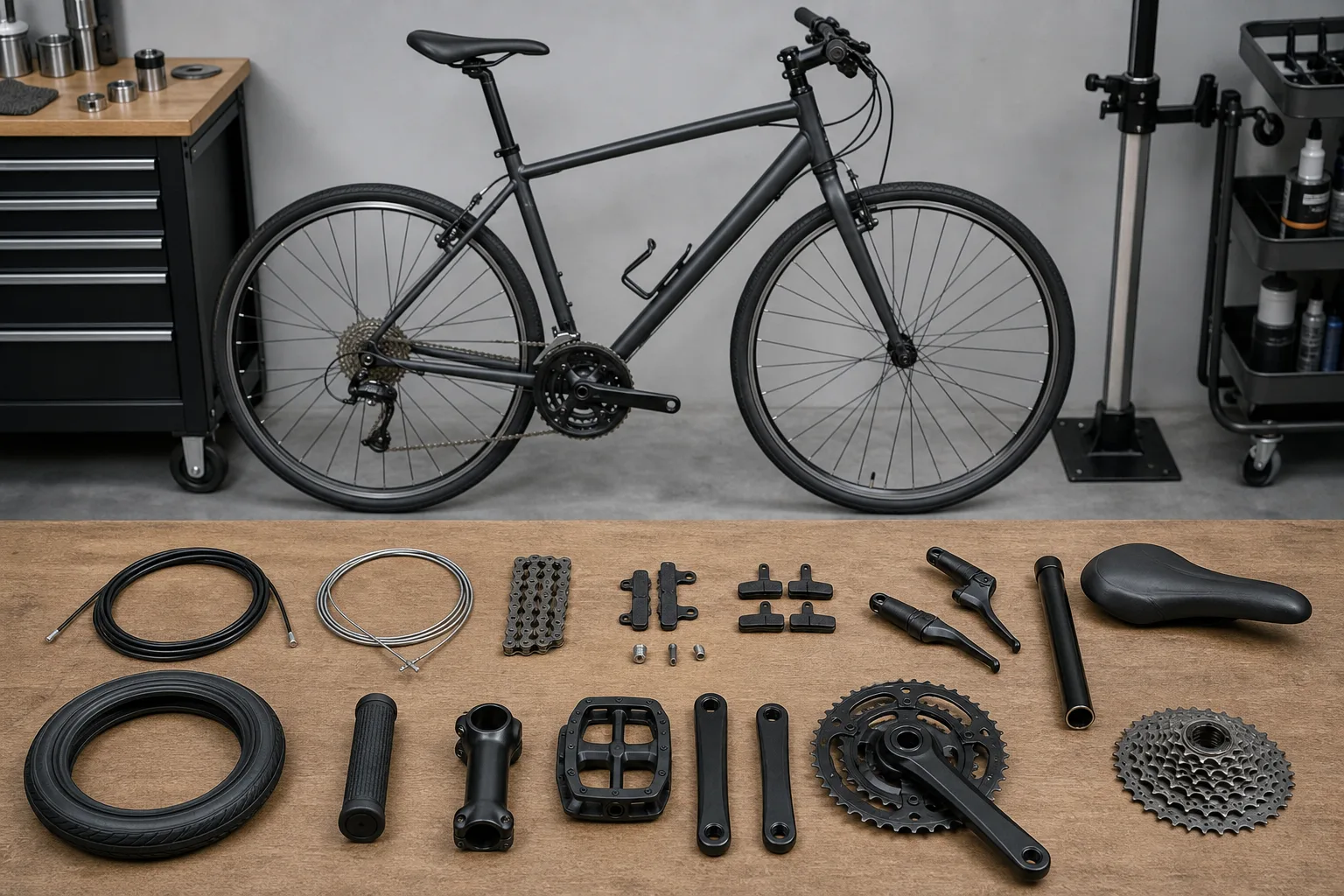
At the bottom of the range you get mechanical disc brakes, often an unbranded caliper with a resin pad and a cable that stretches for the first month. They work. They also need adjusting as the pad wears, they drag if the rotor is even slightly bent, and they ask for a firm hand in the wet. Hydraulic discs, which typically appear somewhere in the middle of the range, self-adjust for pad wear, need roughly a third of the finger pressure, and stay consistent through a long descent. If your route has traffic, hills, or a hand that tires, this is the single upgrade most likely to change how you ride rather than how you feel about riding.
Look past the word hydraulic to the caliper name. A named entry-level hydraulic group from a major manufacturer is a known quantity with pads available at any shop, while a house-brand hydraulic caliper can be harder to service and harder to find parts for three years out. The Consumer Product Safety Commission is responsible for the federal requirements that bicycles sold here must meet, but a floor is not a ranking, and nothing in it tells you which caliper will still feel crisp in year four.
Wheels and tires, where weight actually matters
Cheap wheels are heavy in the worst place, at the rim, where every ounce has to be accelerated from every stoplight, and they are usually built quickly on a machine with uneven spoke tension. That is why the budget bike goes out of true after a few curbs. A mid-price wheel is often the same rim with better tension and a sealed-bearing hub, and it holds its shape. Tires matter more still, and they are the cheapest thing on the bike to change. A supple 38 or 40 millimeter tire with a decent casing, run at a sensible pressure, transforms a harsh bike into a comfortable one for well under a hundred dollars.
Gear range, and what a cheap suspension fork costs you
Count the teeth, not the number of speeds. A nine-speed drivetrain with a 46-tooth low cog and a 30-tooth chainring will climb anything you meet on a commute, while a ten-speed with a narrow cassette will not, and the higher gear count buys you smaller steps rather than more range. The parts you should read closely are the rear derailleur and the cassette, since a mid-tier derailleur shifts under load and holds its adjustment where the entry-level one goes vague once the cable housing packs with grit.
A suspension fork at this price is where money goes to disappear. Below roughly the middle of the range, the fork is an elastomer or a coil with no meaningful damping, it adds three or four pounds high on the bike, it dives every time you brake, and it eventually seizes and cannot be economically rebuilt. The same budget spent on wider tires and a rigid fork gives more comfort, less weight, and nothing to service. A careful reader treats a suspension fork on a paved-road bike as a cost, not a feature.
Where the curve flattens
Past a certain point, and on a bike used for errands and paved paths that point arrives earlier than the catalog suggests, extra spending buys a lighter frame, a slightly crisper shift, and internal cable routing that makes your mechanic sigh. None of it shortens your ride home. What still pays after that is anything you touch or that touches the road: contact points, tires, brake feel, and a wheel that stays true. What almost never pays is a gram counted off a bike you will load with a lock, a pannier, and a week of groceries.
Read the spec sheet as a list of things that will need replacing, and buy the bike whose replaceable parts you can name.